Bank of America has raised its AMD price target to $620, citing the chipmaker's shift from component supplier to full-stack AI systems provider and new multi-billion dollar deals with major AI customers
For years, Nvidia has dominated the conversation around AI chips, with rivals struggling to close the gap. But Bank of America now sees AMD as a credible challenger, raising its price objective for the stock to $620 from $560 and highlighting a shift in how the company is positioned in the AI market. The move follows AMD's most ambitious AI product showcase to date, where the company outlined a strategy that goes beyond selling chips to offering integrated, rack-scale AI systems.
AMD's New Role in AI Infrastructure
Bank of America's latest research note reframes AMD as more than a merchant GPU vendor. The firm now describes AMD as a full-stack, rack-scale accelerator systems supplier, meaning it's competing with Nvidia not just on chip specs but on complete AI hardware and software solutions. This distinction is significant for investors, as it suggests AMD is targeting a larger share of the AI infrastructure market, which is rapidly expanding as demand for generative AI and large language models accelerates.
The bank's $620 price target is based on a 47x multiple of its 2027 estimated non-GAAP earnings per share, which sits in the upper half of AMD's historical valuation range. Bank of America argues this premium is justified by AMD's potential for 50% or higher annual EPS growth and its increasing share in both AI CPUs and GPUs. AMD's own forecasts now put its total addressable compute market at over $2 trillion by 2030, up from $1 trillion previously. The company also raised its AI accelerator market estimate to $1.4 trillion and its server CPU target to $220 billion, reflecting a more aggressive outlook for the next several years.
Helios Rack and Competitive Positioning
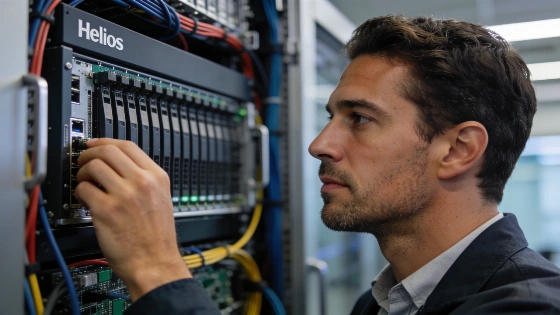
Central to AMD's upgraded thesis is the Helios rack, a fully integrated AI system that combines 72 MI455X GPUs, 18 EPYC Venice CPUs, Pensando networking chips, and ROCm software. The Helios rack is now in full production, with deployments set to begin in the third quarter and ramp up in the fourth. AMD claims each rack delivers roughly 2.9 exaflops of FP4 compute, 1.4 exaflops of FP8, and 31 terabytes of HBM4 memory. Compared to Nvidia's Vera Rubin NVL72, AMD says Helios offers about 15% more FP4 compute for training, 50% more HBM capacity, and up to 30% more tokens per dollar on memory bandwidth, all at a rack price of around $5 million-lower than Nvidia's $6-$7 million per rack.
These technical advantages are only part of the story. AMD's ability to win large, multi-year customer commitments is what gives Bank of America confidence in its long-term prospects. Anthropic, a leading AI company, will deploy up to 2 gigawatts of Helios capacity, with the first gigawatt coming online in the first half of 2027. AMD is also investing up to $5 billion in Anthropic as part of the deal. Meta has already committed to a six-gigawatt, four-year AI infrastructure partnership, and both OpenAI and Meta are set to begin initial deployments of 1 gigawatt each in the second half of 2026, out of larger six-gigawatt agreements.
Customer Pipeline and Recurring Revenue Potential
Bank of America sees these customer wins as more than one-off deals. The firm believes that once a company invests in AMD's rack-scale systems, it is likely to continue through multiple product cycles, given the complexity and cost of switching. AMD's roadmap now extends through 2028, with the MI450 shipping in the second half of 2026, the MI500 arriving in 2027 alongside the Verano CPU, and the MI600 launching in 2028 with the Zen 7 Ferrara CPU and the next generation of Helios systems. This multi-year visibility is rare in the fast-moving AI hardware sector and could support more stable, recurring revenue streams.
For context, AMD reported $22.7 billion in revenue for 2025, up from $23.6 billion in 2024, according to company filings. The company's data center segment, which includes AI hardware, accounted for more than 30% of total revenue in the most recent year, reflecting the growing importance of AI infrastructure to AMD's business model.
Software Ecosystem and Execution Risks
While hardware specs are critical, Bank of America notes that AMD's ROCm software ecosystem is becoming a key differentiator. At its recent event, AMD introduced ROCm.ai, an AI-native developer platform built on ROCm 7, which the company says delivers 3.5 times the inference performance and three times the training performance of the previous version. Third-party analysis from SemiAnalysis and InferenceX found that AMD's MI355X chips achieved up to 40% lower cost-per-token than Nvidia's B200 on certain AI workloads, suggesting AMD is closing the gap on both performance and economics.
Still, Bank of America cautions that execution risk remains high, especially as AMD rolls out its first rack-scale product. The company's reliance on a single manufacturing partner is another potential vulnerability. But the overall tone of the bank's note is optimistic, arguing that AMD's window of opportunity in AI is opening faster than many investors realize.
For investors tracking the broader AI hardware landscape, it's worth noting that Anthropic's own plans to go public could further reshape the competitive field, as discussed in this analysis of Anthropic's IPO ambitions.
As the AI infrastructure market grows, AMD's ability to deliver on its ambitious roadmap and secure long-term customer relationships will be critical to sustaining its momentum against entrenched rivals like Nvidia.
AI hardware is a capital-intensive, rapidly evolving sector where technical leadership can shift quickly. For investors, understanding the interplay between hardware innovation, software compatibility, and customer lock-in is essential. Companies that can offer integrated solutions-combining chips, systems, and developer tools-may be better positioned to capture recurring revenue as AI adoption accelerates. But the risks of execution missteps, supply chain disruptions, and changing customer preferences remain significant, making this a high-stakes market for both companies and shareholders.