Bloom Energy raised its 2026 outlook and reported record revenue, easing investor concerns about delays at Oracle's Project Jupiter. Morgan Stanley says Bloom's backlog and flexible contracts help shield it from project setbacks
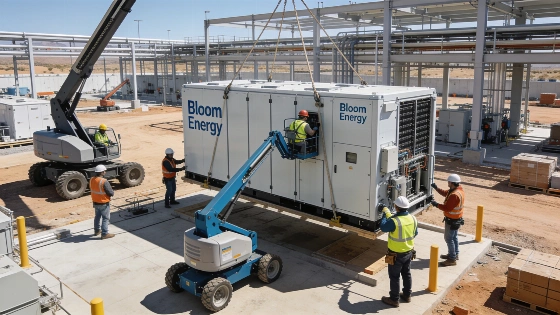
Bloom Energy's ability to deliver on its ambitious growth targets is under scrutiny after a key project with Oracle encountered another regulatory hurdle. The company, which manufactures solid oxide fuel cell systems for on-site power generation at data centers, recently saw a proposed natural gas pipeline for Oracle's Project Jupiter in New Mexico rejected by regulators for a second time. The setback could push back the timeline for deploying up to 2.45 gigawatts of Bloom's fuel cells at the site, raising questions about the impact on Bloom's financial performance.
Despite the delay, Bloom Energy reported record second-quarter revenue and raised its full-year 2026 guidance, signaling confidence in its ability to manage project risks. Shares of Bloom closed up 26.54% at $207.21 on July 30, reflecting renewed investor optimism. According to a July 29 note from Morgan Stanley, the bank maintained its Overweight rating and a $310 price target on Bloom, representing nearly 50% upside from the latest closing price. The firm's analysts argue that Bloom's flexible contracts and ability to redirect equipment to other customers help insulate the company from individual project delays.
Financial Results and Guidance
Bloom's second-quarter results included $1.07 billion in revenue, a 166% increase from the prior year, and a non-GAAP gross margin of 34.3%, up from 28.2%. The company generated $226.4 million in cash from operations, reversing a $213.1 million outflow a year earlier. Bloom raised its full-year revenue guidance to a range of $3.9 billion to $4.2 billion and increased its non-GAAP operating income forecast to $800 million to $900 million. The midpoint of the revenue outlook rose by $450 million, which Morgan Stanley estimates equates to roughly 100 megawatts of additional shipments in the second half of 2026. The company also boosted the midpoint of its operating income forecast by $175 million, or 26%.
Management emphasized that no single project, including Oracle's, is critical to achieving the revised 2026 guidance. Morgan Stanley noted that Oracle could deploy Bloom's fuel cells at other data center locations if Project Jupiter's timeline slips into 2027. The relationship between Bloom and Oracle already spans multiple sites, reducing the risk of overreliance on a single deployment. In addition, some of Bloom's financing partners are contractually obligated to purchase equipment within a set period after placing an order, allowing Bloom to recognize revenue even if construction at the intended site is delayed.
Backlog and Demand
Morgan Stanley estimates that Bloom's equipment backlog exceeded $8 billion at the end of the second quarter, though the company has not formally reported this figure. The estimate is based on management's comments about the pace of new orders and the fact that backlog growth is outpacing revenue. Demand for Bloom's fuel cells extends beyond Oracle, with all major U.S. hyperscalers and more than a dozen AI labs and colocation data center operators having validated its technology. Validation means a customer has completed the technical review needed to consider Bloom's systems for deployment, though it does not guarantee a purchase contract.
To support customers with urgent needs, Bloom is reserving part of its manufacturing capacity for "book-and-ship" orders that require faster delivery. This approach allows the company to offer shorter lead times than traditional utility connections in some markets, and management has suggested that customers may be willing to pay higher prices for quicker access to power. Morgan Stanley views this as a positive signal for Bloom's pricing power. The bank is forecasting positive operating and free cash flow for the remainder of 2026, with deployment estimates of 1.8 gigawatts in 2027 and 4.8 gigawatts in 2028.
Supply Chain and Capacity
Bloom uses scandium oxide in its fuel cell electrolyte and claims its diversified supply chain can support up to 25 gigawatts of annual production. The company says it does not rely on China for scandium oxide, sourcing the material from multiple suppliers and countries. While management remains confident that scandium availability will not constrain growth, Morgan Stanley noted that the latest earnings call did not provide new details on suppliers, procurement volumes, or contracts. The bank believes Bloom's current manufacturing footprint is sufficient for near-term growth but is waiting for a formal commitment to expand capacity beyond five gigawatts annually.
Expanding manufacturing would require significant capital investment and time before new facilities could contribute to shipments. Bloom must also ensure that its backlog converts to completed deliveries without excessive delays from customer construction or installation issues. Morgan Stanley's base-case price target remains $310, with a bull case of $520 and a bear case of $115, the latter assuming increased competition, slower growth, and weaker progress on manufacturing costs. The bank says it would consider raising its forecasts if Bloom secures another major data center customer or commits to a larger factory.
While Bloom's situation echoes the challenges faced by other high-growth technology companies navigating project delays and regulatory risks, the company's strong backlog and flexible business model have helped reassure investors. For example, as seen when ARK Invest doubled down on SpaceX despite share price volatility, some investors are willing to look past near-term setbacks if they believe in the long-term growth story. A recent investment move in the space sector highlights how market participants weigh project risks against future potential.
For the second quarter of 2026, Bloom Energy reported $1.07 billion in revenue, up 166% year over year, and generated $226.4 million in cash from operations. The company's non-GAAP gross margin improved to 34.3%, and its backlog is estimated to exceed $8 billion, according to Morgan Stanley. Shares closed at $207.21 on July 30, up 26.54% for the day.
Fuel cell systems like those produced by Bloom Energy offer data centers a way to secure reliable, on-site power without waiting for new grid connections, which can be delayed by regulatory or infrastructure bottlenecks. These systems convert natural gas or hydrogen into electricity through an electrochemical process, providing a steady power supply that is especially valuable for AI and cloud computing operations. While the technology can reduce dependence on traditional utilities, it also exposes companies to risks related to fuel supply, regulatory approvals, and the need for ongoing capital investment. As demand for data center capacity grows, the ability to manage these risks and deliver on large-scale projects will remain a key factor for both providers and investors.