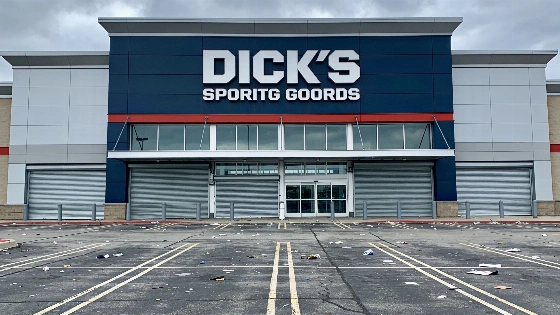
After a 31% plunge in Dick's Sporting Goods shares and the closure of 113 stores-mostly from its Foot Locker acquisition-Goldman Sachs cut its price target by $101, citing margin erosion and integration setbacks that now threaten the retailer's recovery.
Shares of Dick's Sporting Goods (DKS) fell 31% in a single session, wiping out billions in market value, after the company announced the closure of 113 stores and sharply reduced its 2026 earnings outlook. This decline prompted Goldman Sachs to lower its price target for DKS by $101 to $170, highlighting the growing risks from the retailer's troubled Foot Locker acquisition and intensifying price competition in athletic footwear.
As of August 1, 2026, Dick's Sporting Goods operated 3,104 stores after the closure of 113 locations, with 110 of those closures coming from the Foot Locker segment.
Goldman Sachs maintained its Buy rating but cited two main factors for the downgrade: Foot Locker's ongoing underperformance and a highly competitive footwear market driving deeper markdowns. Despite these challenges, Dick's core business achieved a 4.9% comparable sales increase, supported by higher average ticket size and World Cup demand. Consolidated net sales surged 53% to $5.59 billion, largely due to the $1.74 billion revenue contribution from Foot Locker. Gross profit reached $1.9 billion, or 34.8% of net sales, but the company's revised non-GAAP earnings forecast of $11 to $12 per share represents a significant drop from its previous $13.50 to $14.50 range. TheStreet directly attributed the guidance cut to Foot Locker's weak performance and sector-wide margin pressure.
Analysts note that Dick's core business remains resilient, with comparable sales rising 4.9% in the latest quarter even as the acquired Foot Locker segment struggled. This divergence is a key reason why some market watchers maintain a positive long-term view on DKS shares, despite the near-term turbulence and guidance reset.
To offset these challenges, Dick's is focusing on growth initiatives such as DICK'S Media Network and GameChanger, while tightening inventory and promotional strategies. The company's market capitalization has dropped to $12.1 billion-nearly half its peak-and DKS now trades at just 11 times forward earnings, a discount compared to retail peers. Analyst sentiment is mixed: of 21 analysts covering the stock, 12 rate it a Buy, eight Hold, and one Sell, with an average price target of $161, suggesting 21% upside if management meets revised guidance. Some see value in the depressed multiple, particularly if Dick's can capitalize on competitors' weaknesses, as observed in other retail segments earlier this year.
However, the sector's heightened promotional activity and shifting consumer preferences continue to pose risks. Retailers are cutting prices to clear unsold inventory, compressing margins and increasing earnings volatility-especially for those with international exposure. Dick's management has reset expectations, but a sustainable recovery will depend on disciplined execution and renewed demand for new product launches. Investors attracted by DKS's valuation must weigh the potential for a turnaround against the operational setbacks and integration challenges that have characterized the past year.
Retail acquisitions often promise scale and synergy, but Dick's Sporting Goods now demonstrates how integration risk can undermine even a strong core business. The decision to lower guidance and close underperforming stores is a necessary adjustment, yet it also signals that the Foot Locker deal has not delivered as intended. Until Dick's restores profitability and regains investor confidence, its discounted valuation remains justified. The company's path forward will require concrete operational improvements-not just headline growth-to support a re-rating and deliver lasting value to shareholders.