Google plans to move all Pixel device manufacturing out of China by 2027, shifting production to India and Vietnam. The move could affect supply chain stability, component costs, and the company's leverage with suppliers
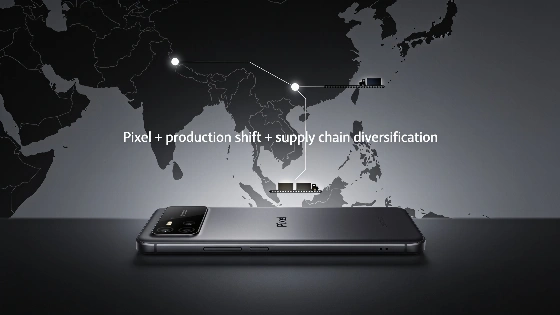
When U.S. consumers pick up a new Pixel phone, watch, or earbuds, few consider where the device was assembled. For Alphabet investors and industry analysts, however, the country of origin is becoming a critical factor. Google is preparing to relocate all manufacturing of its Pixel hardware-including smartphones, watches, and wireless earbuds-out of China by 2027, according to reporting from TechRepublic. The company has reportedly instructed suppliers to get ready for the transition, with India and Vietnam set to become the primary production hubs.
This supply chain overhaul comes as Google's hardware ambitions expand. While Pixel remains a niche player compared to Apple's iPhone or Samsung's Galaxy lineup, the devices serve as a showcase for Google's Gemini AI, Android platform, and broader ecosystem. The company shipped about 12 million Pixel phones in 2025, and shipment volumes are projected to rise 8% to 10% in 2026, potentially reaching 13 million units, according to AndroidCentral. For Google, the move is less about dominating the smartphone market and more about gaining strategic control over manufacturing and components.
Manufacturing Moves
Google's shift away from China is not a sudden pivot. In 2023, the company began producing Pixel 8 smartphones in India, identifying the country as a priority market and signaling plans to increase local production capacity. By August 2024, the first Made-in-India Pixel 8 devices were rolling off assembly lines. Vietnam, meanwhile, has become increasingly important for Google's premium devices, with investments in tooling and testing infrastructure supporting mass production there.
The distinction between final assembly and new-product introduction is significant. While assembling devices in a new country is one challenge, transferring the engineering, testing, and manufacturing expertise required to launch new products is more complex. If India and Vietnam can absorb these higher-value tasks, Google will reduce its reliance on China not just for assembly, but for critical know-how as well. For consumers, the change may be invisible-a Pixel built in Vietnam could feel identical to one made in China. But for Google, diversifying manufacturing sites offers a hedge against tariffs, geopolitical tensions, shipping disruptions, and component shortages.
Supply Chain Leverage
Behind the scenes, Google is also consolidating its memory chip procurement across its cloud and smartphone divisions, increasing its bargaining power with suppliers such as Micron Technology, Samsung Electronics, and SK Hynix. This is especially relevant as the global surge in AI demand has led memory manufacturers to prioritize high-bandwidth chips for AI accelerators, tightening supply for conventional memory used in smartphones and PCs. Google's dual role as a major buyer of both AI infrastructure and consumer electronics components could give it an edge in securing critical parts for Pixel devices.
Alphabet's capital expenditures are expected to reach $180 billion to $190 billion in 2026, roughly six times the company's 2022 level, with most of that spending directed toward technical infrastructure. In the first quarter of 2026, Google Cloud generated $20 billion in revenue, and its backlog reached $462 billion, reflecting the scale of its AI ambitions. This buying power is unusual among smartphone makers and may help Google weather supply chain disruptions that could impact smaller competitors.
Pixel's Scale and Transition Risks
Google's relatively modest smartphone volumes may actually make the transition out of China more manageable. Moving production for 12 to 13 million devices annually is a different challenge than shifting hundreds of millions of units, as Apple or Samsung might face. The company's 8% to 10% shipment growth target for 2026 suggests confidence in its ability to expand Pixel sales while reconfiguring its manufacturing footprint.
Still, removing final assembly from China does not mean the country will disappear from Google's supply chain. Many components, materials, and subassemblies may continue to originate in China, even if the finished product is assembled elsewhere. The move should be seen as diversification rather than a complete decoupling. This approach aligns with Google's broader strategy of integrating Pixel devices more deeply into its AI-driven consumer ecosystem, where hardware, software, and cloud infrastructure are increasingly interdependent.
For investors, the most significant change may not be visible on the device itself, but in Google's ability to manage supply chain risks and negotiate with suppliers. As the company's hardware ambitions grow, so does the importance of where-and how-its devices are built. This shift comes as other major investors, such as Bill Ackman's Pershing Square, have recently adjusted their positions in Alphabet, as detailed in a recent analysis of major fund moves.
Key Figures
According to company disclosures and industry reports, Google shipped approximately 12 million Pixel smartphones in 2025, with projections for 8% to 10% growth in 2026. Alphabet's planned capital expenditures for 2026 are between $180 billion and $190 billion, with Google Cloud reporting $20 billion in first-quarter revenue and a $462 billion backlog at the end of Q1 2026. India and Vietnam are expected to become the main alternatives for Pixel production as the company phases out manufacturing in China by 2027.
As Google's hardware and AI strategies converge, the company's ability to secure components and manage manufacturing risks will be closely watched by investors and competitors alike.
Supply chain diversification is a common strategy among global technology firms seeking to reduce exposure to geopolitical risks and single-country disruptions. While moving final assembly out of China can help mitigate some vulnerabilities, it rarely eliminates them entirely. Many high-value components, such as semiconductors and advanced materials, are still sourced from a global network that often includes Chinese suppliers. For U.S. investors and consumers, understanding the difference between assembly location and component origin is key to assessing the true impact of supply chain shifts on product availability, pricing, and long-term risk.