
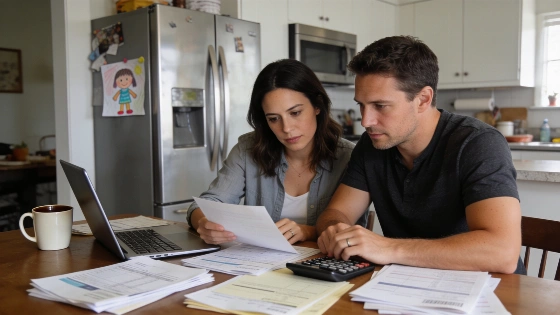
Households led by adults in their 30s now average $85,114 in annual spending, with housing and transportation accounting for nearly half of all expenses-reflecting a shift toward higher fixed costs and long-term financial obligations
For many Americans, the decade between ages 30 and 39 marks a turning point in household finances. According to the latest Consumer Expenditure Survey from the U.S. Bureau of Labor Statistics (BLS), households headed by someone in their 30s spent an average of $85,114 in 2024. That translates to roughly $7,100 per month, with housing and transportation alone consuming about half of the total budget. These figures highlight how fixed costs and long-term commitments increasingly shape financial decisions during this stage of life.
Housing remains the single largest expense for this age group, averaging $1,537 per month for mortgage or rent payments. Additional housing-related costs, such as utilities and household operations, add another $614 monthly. Transportation is the next biggest category, with average monthly spending of $1,187. This includes car payments, insurance, fuel, maintenance, and public transit-costs that often rise as families grow or as two working adults require separate vehicles.
Beyond shelter and mobility, households in their 30s are also allocating significant sums to future security. Contributions to retirement accounts and personal insurance premiums, including life and non-government disability insurance, average $1,030 per month. Notably, this amount exceeds what the typical household spends on groceries, which comes in at $893 per month, with an additional $475 spent on dining out. These patterns reflect a growing emphasis on long-term planning and risk management as financial responsibilities expand.
Rising Expenses and Shifting Priorities
Spending tends to climb sharply from the 20s into the 30s, driven by larger homes, higher grocery bills, and more recurring expenses tied to family life. While the 30s are not the peak spending years-those typically arrive in the 40s and 50s-this decade is often when households lock in major financial commitments. Mortgages, car loans, childcare, and insurance policies become regular features of the monthly budget, making it harder to trim costs quickly if income fluctuates.
As incomes generally rise during this period, so do obligations. Many households find that lifestyle upgrades, such as moving to a larger home or purchasing a second vehicle, are accompanied by higher fixed costs. At the same time, the need to save for retirement and protect against unforeseen risks becomes more pressing, prompting increased contributions to 401(k) plans, IRAs, and insurance products.
Where the Money Goes
The BLS data breaks down average monthly spending for households led by someone in their 30s as follows: $1,537 for housing, $1,187 for transportation, $1,030 for life insurance and retirement contributions, $893 for food at home, $614 for utilities and household operations, and $475 for food away from home. These categories account for the bulk of the typical budget, leaving less room for discretionary spending or rapid adjustments in response to economic shocks.
For context, the BLS reports that overall consumer prices rose 3.4% in the 12 months ending April 2024, with shelter costs up 5.5% year-over-year. Mortgage rates have remained elevated, with the average 30-year fixed rate hovering near 7% for much of 2024, further increasing the burden of homeownership for new buyers. These trends have made it more challenging for households in their 30s to manage both current expenses and long-term savings goals.
Implications for Financial Planning
The spending patterns revealed by the BLS survey underscore the importance of careful budgeting and forward-looking financial planning in early adulthood. With nearly half of all spending tied up in housing and transportation, many households have limited flexibility to adjust their budgets quickly. Rising costs for childcare, healthcare, and insurance can further strain finances, especially for families with young children or those facing unexpected expenses.
For those in their 30s, the challenge is often balancing immediate needs-such as housing, transportation, and family expenses-with the imperative to save for retirement and build financial resilience. While higher incomes can help offset some of these pressures, the risk of overcommitting to fixed costs remains a concern, particularly in an environment of persistent inflation and elevated interest rates.
Based on data from the U.S. Bureau of Labor Statistics, these trends highlight the need for households to regularly review their spending, reassess long-term commitments, and consider strategies for managing both current obligations and future goals.
Understanding the structure of household budgets is critical for long-term financial health. Fixed costs-such as mortgage payments, car loans, and insurance premiums-can provide stability but also reduce flexibility if income drops or expenses rise unexpectedly. Variable costs, like dining out or entertainment, are easier to adjust but often make up a smaller share of the budget as fixed obligations grow. For households in their 30s, regularly evaluating both types of expenses and maintaining an emergency fund can help manage risk and support financial goals as circumstances change.