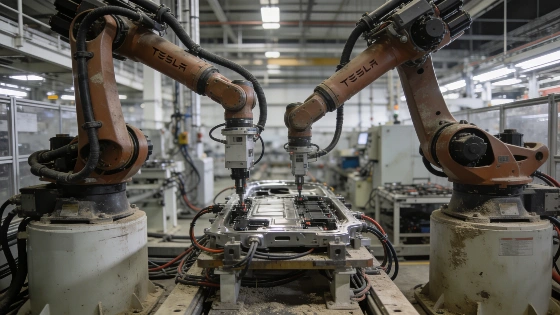
Tesla's rising R&D costs and shrinking margins have Wall Street watching for concrete progress on Robotaxi and Optimus. Morgan Stanley says the next quarter must deliver measurable results to justify the company's AI ambitions
Tesla's latest financials have sharpened Wall Street's focus on whether the company's ambitious bets on artificial intelligence and automation are translating into real business results. According to a recent note from Morgan Stanley, Tesla's spending is climbing, gross margins are under pressure, and free cash flow has turned negative-raising the stakes for the company to show tangible progress in its next quarterly report.
Andrew Percoco, who now leads Tesla coverage at Morgan Stanley, maintained an Equal Weight rating and a $415 price target on the stock, which was trading near $330 at the time of his report. While the long-term AI thesis remains intact, Percoco emphasized that investors need to see measurable advances, especially in Tesla's Robotaxi and Optimus projects. The urgency is growing as higher research and development expenses and ongoing cash burn have made investors less willing to accept promises without proof.
Robotaxi: From Hype to Hard Numbers
For Tesla's Robotaxi initiative, Morgan Stanley is looking for more than just expansion into new cities. The focus is shifting to operational metrics: ride volume per vehicle, utilization rates, and whether the service can operate at scale without heavy reliance on remote human support or costly hardware upgrades. Investors want to see that Robotaxi can generate meaningful revenue and operate efficiently in existing markets before crediting geographic growth.
One positive sign from the last quarter was the 55% Full Self-Driving (FSD) attach rate on North American deliveries, far above Morgan Stanley's previous expectations of 25% to 30%. This data point suggests growing consumer interest in Tesla's autonomous features, but it also raises expectations for Robotaxi's ability to scale profitably. Morgan Stanley forecasts Tesla's Robotaxi fleet could reach 1,500 vehicles by year-end and expand to 30,000 by 2030, but stresses that productivity per vehicle is now more important than fleet size.
Optimus: Beyond the Production Line
On the Optimus humanoid robot project, Morgan Stanley wants evidence that goes beyond Tesla's frequent references to the start of production. The firm is watching for public demonstrations of a functioning production version, proof that Optimus can operate inside Tesla's own facilities without constant human oversight, credible manufacturing cost estimates, and-most importantly-commercial orders or contracts from outside customers. Investors are looking for signs that Optimus can perform reliably in real-world industrial settings, not just in controlled factory environments.
While Tesla has stated that Optimus is already working inside its factories, the leap from internal use to commercial viability remains unproven. The market is waiting for external validation, such as customer orders or partnerships, to confirm that Optimus is more than a technological showcase.
Financial Pressure and Investor Patience
The financial backdrop is adding pressure. Tesla's gross margins have narrowed as R&D spending rises, and the company is burning cash to fund its AI-driven projects. Morgan Stanley's $415 price target implies about 26% upside from recent levels, but the firm is not ready to recommend the stock as a primary buy until Tesla demonstrates that its investments are producing measurable business results. The note makes clear that the risk-reward balance depends on Tesla's ability to turn spending into scalable, profitable operations.
For context, Tesla reported $25.17 billion in revenue for the second quarter of 2026, but free cash flow was negative as the company ramped up investment in new technologies. Gross margin fell to 17.9% from 19.2% a year earlier, reflecting both competitive pricing and higher costs. These figures underscore why Wall Street is demanding more than just vision from Tesla's leadership.
As investors weigh the risks and rewards of Tesla's AI strategy, some are drawing parallels to other high-profile bets on artificial intelligence in the market. For example, Michael Burry's recent moves against AI-linked stocks have sparked debate about whether the sector's valuations are justified. For a deeper look at how skepticism is shaping the broader AI investment landscape, see this analysis of Burry's position on Nebius and related companies: how one prominent investor is betting against the AI boom.
Ultimately, Morgan Stanley's message is not that Tesla's AI ambitions are misplaced, but that the company must now deliver hard evidence that its investments are paying off. The next quarter will be a critical test of whether Tesla can turn its technological lead into sustainable financial performance.
When evaluating companies like Tesla, investors should pay close attention to the distinction between visionary product announcements and operational execution. While bold forecasts and new technologies can drive excitement and short-term price moves, long-term value creation depends on a company's ability to convert innovation into profitable, scalable businesses. Metrics such as free cash flow, gross margin, and utilization rates offer a clearer picture of whether a company's strategy is working. As the market matures, investors are likely to reward firms that can back up their ambitions with consistent, transparent results.