Saudi oil exports through the Red Sea are now hidden from view as tankers disable tracking to avoid attacks, creating major uncertainty for global oil markets and raising the risk of sudden price swings
For years, oil has been one of the most transparent commodities in global trade. Tankers carrying Saudi crude routinely broadcast their positions, allowing analysts and traders to track shipments in near real time. This transparency has helped set prices and manage supply expectations from the Persian Gulf to U.S. gas stations. But that clarity is now breaking down as geopolitical risks escalate in the Red Sea.
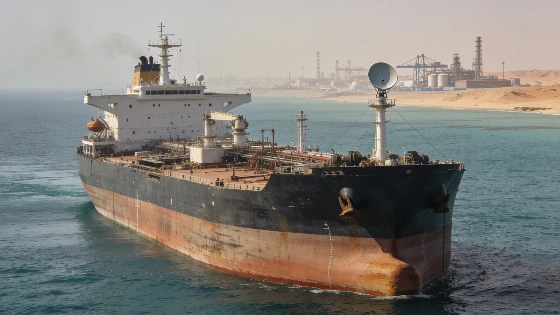
Since late July, Saudi oil tankers departing the Red Sea port of Yanbu have begun switching off their Automatic Identification System (AIS) transponders, effectively vanishing from satellite tracking. This move is a direct response to a maritime embargo declared by Yemen's Houthi movement, which has threatened and claimed attacks on Saudi-linked vessels and oil infrastructure along the Red Sea coast. According to Reuters, nearly all recent Yanbu loadings have been conducted without continuous tracking, making it nearly impossible for market participants to verify how much oil is actually leaving the region.
Data Blackout and Market Uncertainty
The sudden disappearance of Saudi oil tankers from public tracking systems has created a major information gap. Previously, firms like Vortexa, Kpler, and AXSMarine could provide reliable estimates of Saudi exports. Now, their numbers diverge sharply. For the week starting August 3, Vortexa estimated Yanbu loadings at 2.38 million barrels per day, while Kpler reported a much lower 1.78 million, and AXSMarine calculated just 850,000 barrels per day. The spread between the highest and lowest estimates exceeds 1.5 million barrels per day-nearly as large as the entire global oil supply deficit projected for the current quarter by the International Energy Agency.
This lack of visibility is not just a technical issue. It directly affects how traders, refiners, and investors assess supply risks and price oil contracts. Insurance costs have also surged, with war risk premiums for Red Sea transits jumping about 150% after the embargo, according to Business Insurance. The market is now forced to trade on incomplete or conflicting data, raising the risk of sudden price corrections if the true export numbers are revealed later.
Rerouting and New Vulnerabilities
Saudi Arabia has not stopped exporting oil-it has simply changed its routes. With the southern exit through the Bab al-Mandeb Strait now more dangerous, more Saudi crude is being sent north through the Suez Canal or Egypt's SUMED pipeline, which connects the Red Sea to the Mediterranean. Kpler data cited by Reuters shows that vessel traffic through Bab al-Mandeb has dropped from about 50 ships a day before the blockade to just 32. Meanwhile, crude loadings at Egypt's Sidi Kerir terminal hit a record 2.17 million barrels per day last week, with roughly 90% of that volume coming from Saudi Arabia, according to Vortexa.
But the northern route is not immune to risk. On July 30, drones struck two liquefied natural gas carriers at Egypt's Port of Damietta, highlighting that alternative corridors can also be targeted. Tanker operators report that navigating the Red Sea has become increasingly challenging, and the knock-on effects are already shifting global trade patterns. As European refiners take more Saudi barrels, West African crude is being redirected toward Asia, further complicating supply chains.
Market Impact and Investor Risks
Despite these disruptions, oil prices have not spiked dramatically. On August 12, Brent crude settled at $88.98 per barrel and West Texas Intermediate at $83.27, according to CNBC. Both benchmarks eased slightly the following morning. The market appears to believe that Saudi Arabia can maintain exports through alternative routes, but this confidence is built on data that is now highly uncertain. Earlier this summer, the feared oil price spike did not materialize because workarounds kept supply flowing and the market could verify that they were effective. Now, with verification gone, the risk is that volatility will arrive not with the next missile strike, but when export estimates are revised-potentially weeks after the fact.
This disconnect between official statements and what can be independently tracked is already visible. While Saudi officials claim regional oil flows are above prewar levels, vessel-tracking firms say their data cannot confirm those figures. For investors, this means that the next major move in oil prices may come not from breaking news, but from a quiet revision in a monthly report. As recent coverage of market disconnects has shown, headline numbers can mask underlying risks that only become clear after the fact.
According to the International Energy Agency's August 2026 Oil Market Report, the global oil market is expected to face a supply deficit of 1.8 million barrels per day in the third quarter, more than double the previous month's estimate. This tightening balance makes accurate export data even more critical for market stability and price discovery.
Oil market transparency relies on a chain of data-from satellite tracking to analyst estimates to official reports. When one link breaks, as it has with Saudi tankers going dark, the entire system becomes less reliable. For U.S. investors, refiners, and consumers, this means greater uncertainty around gasoline prices, energy stocks, and inflation expectations. The risk is not just that supply could be disrupted, but that the market may not realize it until after prices have already adjusted.
Understanding how oil shipments are tracked is essential for anyone following energy markets. Tankers are typically required to keep their AIS transponders on for safety and regulatory reasons, allowing their movements to be monitored by satellite. When ships go dark, it becomes much harder to verify export volumes, increasing the potential for misinformation and market surprises. This opacity can lead to sharper price swings, as corrections happen in bursts rather than gradually. For investors and consumers alike, the lesson is to pay close attention to how data is collected and reported-not just the headline numbers themselves.