The S&P 500 has climbed 27.6% since Trump's November 2024 election victory. Tariffs, higher oil prices and rising bond yields are tightening conditions for AI and other growth stocks.
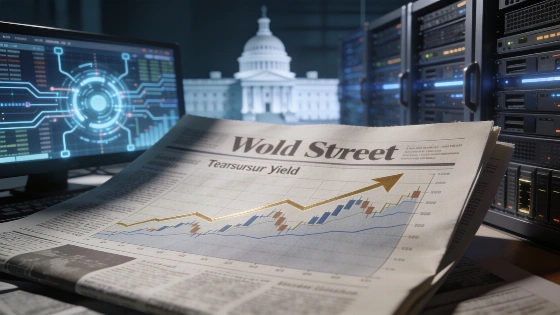
On September 25, the S&P 500 and Nasdaq rose as investors bought AI shares, despite higher oil prices and surging Treasury yields, Reuters reported. A Reuters Treasury market review said the 10-year yield reached 5.2251%, a fresh 19-year high. The 30-year yield touched 5.5016%, a level not seen since 2004. Reuters linked the jump to firm economic data, concerns about government debt and elevated oil prices. There was no single trigger.
Higher rates make it more expensive for technology companies to borrow as they build data centers. Rising Treasury yields also give investors an alternative to speculative growth stocks. If those pressures last, investors may be less willing to bet on artificial intelligence.
Stocks have climbed during Donald Trump's second term, even as his administration's economic policies unsettled trade and energy markets. The gains have coincided with corporate tax breaks, lighter regulation in areas such as energy and generative AI, and confidence that U.S. technology companies can keep expanding. That does not prove policy caused the gains, or that the rally will continue.
Goldman Sachs estimates hyperscalers will spend about $800 billion on capital expenditures in 2026, while the 2027 consensus is $1.1 trillion. The bank estimates AI applications would need roughly $1 trillion in annual revenue for infrastructure players to earn confident returns.
AI spending meets a funding test
Wall Street's AI bet depends on huge investments and future returns. Goldman Sachs expects global AI spending to exceed $1 trillion in 2026. Companies will still need to show that the infrastructure and models under development can earn sustainable returns. The bank estimates hyperscaler capital expenditures at about $800 billion this year, with the 2027 consensus at $1.1 trillion, according to its Goldman AI spending analysis.
Model developers such as Anthropic and OpenAI continue to spend heavily. OpenAI is expected to record about $278 billion in negative free cash flow from 2026 through 2030 and incur roughly $856 billion in compute and infrastructure costs by 2030, according to Financial Times reporting. Hyperscalers, too, could run negative free cash flow as they commit capital to costly hardware and equipment.
Higher financing costs can make these projects harder to fund and less appealing to investors. Big spending alone does not guarantee lasting profits. Low-cost, often open-source Chinese models are gaining ground on U.S. competitors. If customers can get capable tools for less, American developers may have less room to earn back their investment.
AI stocks face two tests: Can demand support the buildout? And can companies turn that demand into lasting profits? A growth stock's value depends heavily on expected future earnings. When interest rates rise, those earnings are worth less in today's dollars. Valuations can fall before a company reports weaker results.
That is a real risk.
Rising yields are 'causing an understandable weakness in the tape,' while competition for capital from AI hyperscaler spending 'pressures the consumer with higher rates.'
Policy pressure reaches markets
The figures point to a sharp shift in financial conditions. The S&P 500 is up 27.6% since Trump's November 2024 election victory. Brent crude has risen 70% since the start of 2026. The Federal Reserve's benchmark rate is 3.75% to 4.00%, and the 10-year Treasury yield has reached 5.2%. These figures cover different measures and periods. Together, they help explain why investors may rethink the cost of risk and the outlook for businesses that need large amounts of capital.
Tariffs raise the cost of imported finished goods and components. The war in Iran has disrupted shipping through the Strait of Hormuz and Bab el-Mandeb, routes that matter to global oil and gas trade. Higher energy and import costs can add to inflation. The article's figures state that the Federal Reserve has raised its benchmark rate to 3.75% to 4.00% to contain price pressures. Tighter monetary policy also raises financing costs for companies investing in data centers.
Bond yields create another source of competition. When the 10-year Treasury offers a higher return, investors may want more compensation before taking on the uncertainty of a high-growth company whose profits are expected far in the future. Treasury bonds are not interchangeable with stocks. They carry different risks, and their market prices can fluctuate. Still, rising yields can make speculative investments less appealing.
That can change fast.
Risk management without market timing
A downturn is possible, but it is not scheduled. Federal Reserve tightening has historically coincided with stock-market underperformance. That pattern cannot tell investors when a decline will start or how deep it might be. Valuation measures offer warnings, not trading signals. They can help investors understand the risks they are taking, but they cannot reliably time a market peak.
Investors can check how much of their portfolios depends on a small group of high-growth companies. They can maintain diversification and match investments to their time horizons and risk tolerance. These steps cannot prevent losses. They can reduce dependence on any one outcome, including the belief that AI spending will quickly produce profits or that policy-driven volatility will soon fade.