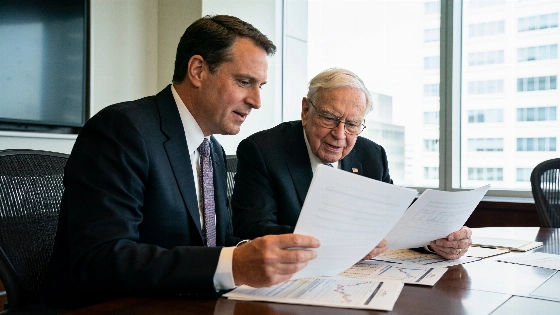
Berkshire Hathaway's leadership transition to Greg Abel has kept the company's investment strategy steady, with Buffett's influence still evident as the firm maintains major holdings in Apple, American Express, and Coca-Cola
Berkshire Hathaway's transition from Warren Buffett to Greg Abel as CEO has been closely watched by investors, many of whom are concerned about whether the company's disciplined investment approach would shift under new leadership. Despite the change at the top, the company's core strategy remains intact, with Abel and Buffett maintaining a collaborative relationship that ensures continuity in decision-making. According to reporting by Yahoo Finance, Abel continues to consult with Buffett regularly, and both leaders are aligned on the company's direction and investment philosophy.
Buffett's ongoing involvement, even after stepping down as CEO, has helped reassure shareholders that Berkshire's approach to selecting investments-focusing on high-quality companies with durable competitive advantages-remains unchanged. While there have been some adjustments in the portfolio, such as the addition of Alphabet to the top holdings, the methodology for evaluating opportunities is consistent with the principles that have guided Berkshire for decades. The company's largest positions continue to be Apple, American Express, and Coca-Cola, which together account for nearly half of the portfolio's value.
Portfolio Adjustments and Strategy
Recent changes in Berkshire's holdings have drawn attention, particularly the move to add Alphabet to the portfolio's top five positions. This adjustment, initiated by Buffett himself, signals that while the company is open to new opportunities, it is not abandoning its established criteria for investment. The focus remains on businesses with strong brands, reliable cash flows, and the ability to withstand economic cycles. This disciplined approach has historically allowed Berkshire to weather market volatility and deliver long-term returns for shareholders.
For investors, the message is clear: leadership succession at Berkshire was carefully planned, and the transition has been executed with minimal disruption. Abel's management style is described as closely aligned with Buffett's, and both leaders have emphasized that neither is making decisions the other would not support. This mutual understanding has helped maintain stability and confidence among shareholders, even as the broader market environment has become more challenging.
Stock Performance and Market Context
In 2024, Berkshire Hathaway's stock has declined by about 3%, underperforming the S&P 500 over the same period. This short-term dip comes after a strong five-year run, during which the stock delivered approximately 75% total returns. The company's performance reflects both the resilience of its core holdings and the impact of broader market trends, including shifts in technology, consumer behavior, and interest rates. While Berkshire is not immune to market downturns, its diversified portfolio and conservative investment philosophy have historically provided a measure of downside protection.
According to Berkshire Hathaway's 2023 annual report, the company ended the year with more than $350 billion in equity securities and over $150 billion in cash and cash equivalents. Apple remained the largest single holding, representing more than 40% of the equity portfolio's value at year-end. The company's substantial cash reserves provide flexibility to pursue new investments or weather periods of market stress without being forced to sell assets at unfavorable prices.
Long-Term Perspective for Investors
For many shareholders, Berkshire Hathaway's reputation as a "safe haven" stock is rooted in its history of steady management and disciplined capital allocation. The company's approach is not designed to chase short-term gains but to build value over decades. This philosophy may not always deliver market-beating returns in every year, but it has proven effective during periods of volatility and uncertainty. Investors who prioritize stability and long-term growth often view Berkshire as a core holding, especially when market sentiment turns risk-averse.
Understanding Berkshire's investment strategy requires recognizing the trade-offs between growth and safety. The company's preference for established businesses with strong fundamentals means it may lag during speculative rallies but tends to outperform during downturns. For individual investors, this highlights the importance of aligning portfolio choices with personal risk tolerance, time horizon, and financial goals. While no investment is without risk, Berkshire's model offers a case study in the value of patience, preparation, and consistent execution.