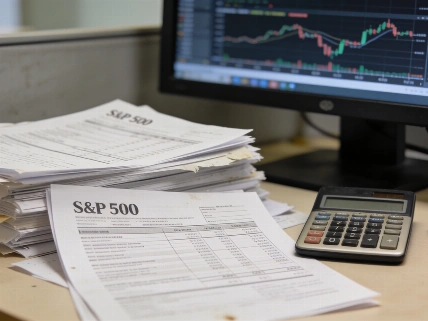

Hartford's historical figures put the typical S&P 500 bear-market decline at 35%. Investors can review which holdings still fit their long-term plans without assuming a downturn is near.
Hartford's historical figures put the typical S&P 500 bear-market decline at 35% over roughly 10 months. That is a pattern, not a forecast.
Investors do not need to predict a bear market to ask whether every stock in their portfolio deserves to stay there. A useful review tests which holdings they would still want after a prolonged decline. It is not an attempt to flee the market.
Selling too early can hurt as much as holding a weak investment through a downturn. The case for a portfolio check is narrower: find positions that no longer have a durable place in a long-term plan. The market may not be heading into a bear market at all.
The S&P 500 has entered bear-market territory 11 times since 1957. One Yardeni Research review estimated that it takes about a year, on average, to reach a bear-market bottom, though the pandemic decline bottomed in 33 days and the dot-com downturn took more than 2.5 years.
What a bear market means
A routine correction is not the same as a bear market. A bear market is commonly defined as a 20% decline from a market peak. An ordinary correction may be shorter and need not come with major economic strain. Hartford's historical figures put the typical S&P 500 bear market at a 35% fall from its peak over roughly 10 months.
The warning case in this analysis points to rising interest rates, inflation's pressure on the economy and the prospect of another yield-curve inversion. A historical yield-curve review found that an inverted curve preceded each of the last eight U.S. recessions dating back to the 1960s. The signal was less reliable in the early 2020s.
Evercore ISI strategists have also cautioned that past inversions often coincided with volatility and sideways trading. They did not necessarily mark the end of a long-term bull market. These conditions can weigh on confidence and markets, but they do not prove a bear market has begun or show when one might arrive. Investors cannot reliably tell from these signals alone whether a lasting decline is near.
By late September 2026, the gap between 2-year and 10-year U.S. Treasury yields had narrowed to about 31 basis points, from roughly 40 basis points a month earlier. The 2-year yield remained below the 10-year yield, so the curve had not inverted at that point.
Sort core from marginal
Trying to sell at a market high and buy back at a low is a difficult strategy. Investors can instead test each holding against their long-term conviction. Which investments would they keep through an extended price decline? Which would they hesitate to own even if the market later recovered? That second group deserves a closer look, especially if the original reason for holding it no longer stands.
This is not a call to sell every stock that could fall. A company that an investor still believes belongs in a long-term portfolio may remain a core holding through a painful, temporary setback. A position without a clear rationale may be more exposed to a downturn and less likely to fit the investor's next-stage plan. The right choice depends on the investor's goals and time horizon, not a universal list of stocks to exit.
A separate downturn checklist covers cash, diversification and borrowing. This review asks whether individual holdings still merit a place in the portfolio. Together, the questions make preparation more concrete without turning it into a bet on the next market move.
Keep the uncertainty in view.
Keep the uncertainty in view
If a downturn does not arrive, selling a stock an investor no longer wants may leave cash available for a more compelling long-term opportunity. Cash is not automatically a better investment, though. Keeping it on the sidelines can mean missing gains if prices rise. The point is not to treat a possible bear market as certain. It is to avoid keeping marginal positions just because selling feels like a market-timing decision.
The 20% threshold describes a market decline. Hartford's typical 35% S&P 500 drawdown describes a historical average. Neither tells investors what the next decline will look like. A bear market can test a portfolio's value and an investor's willingness to stay with it.
Separating durable holdings from positions that lack conviction is a measured way to prepare. It is not a prediction. And it is more defensible than selling core investments on the assumption that a downturn is inevitable.