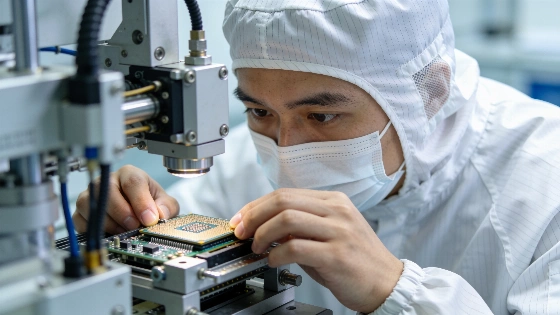
Bank of America projects global cloud capital spending to hit $1.18 trillion by 2027, fueling demand for chipmaking equipment from Applied Materials, Lam Research, and KLA as AI infrastructure expands and factory orders rise
Bank of America has sharply raised its forecast for global cloud capital spending, now expecting it to reach $1.18 trillion in 2027 as artificial intelligence drives a new wave of data center construction. This surge is set to ripple through the semiconductor supply chain, with equipment makers Applied Materials, Lam Research, and KLA positioned to benefit if chip manufacturers ramp up production to meet demand for advanced processors and memory.
These three companies supply the specialized machinery needed to fabricate and inspect the chips powering AI servers. As cloud providers like Amazon, Microsoft, and Google invest in new data centers, they purchase finished processors and high-bandwidth memory from chipmakers. When server orders outpace current manufacturing capacity or require more complex designs, chip manufacturers must expand their factories or add new production steps-moves that translate into fresh equipment orders for Applied Materials, Lam Research, and KLA.
Cloud Spending and Equipment Demand
According to Bank of America's August 2 semiconductor sector note, the $1.18 trillion estimate for 2027 is about 38% higher than projected 2026 spending and $39 billion above the bank's previous forecast. The bank identifies semiconductor capital equipment as one of five chip markets likely to benefit from this investment wave, alongside compute, memory, power semiconductors, and optical components. Applied Materials, Lam Research, and KLA are all rated Buy within BofA's semiconductor coverage, with price targets of $720, $385, and $260, respectively. These targets depend on cloud construction translating into higher chip demand and, in turn, more equipment orders.
Capital expenditure in this context covers not just servers and processors, but also the buildings, power systems, and networking gear that make up a modern data center. BofA estimates that customer commitments and cloud backlogs at the four largest U.S. providers now exceed $2.3 trillion, up from $2 trillion the previous quarter. Oracle alone reported $638 billion in remaining performance obligations, with $75 billion in hardware already prepaid or supplied for large AI contracts. The five largest U.S. cloud providers have raised $270.1 billion in capital for 2026, including bonds, loans, equity, and project financing, giving them the resources to continue multi-year construction projects.
How Equipment Makers Fit In
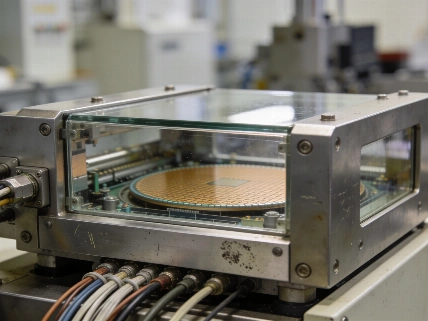
Applied Materials, Lam Research, and KLA each play a distinct role in the chipmaking process. Applied Materials provides tools for creating and modifying the microscopic layers on silicon wafers, serving both leading-edge processors and high-bandwidth memory, as well as advanced packaging that connects these components. Lam Research specializes in deposition and etch systems, which add and remove layers to form the intricate structures inside chips. KLA focuses on inspection and measurement systems that detect defects early, helping manufacturers avoid costly errors as chip designs become more complex.
Recent earnings underscore the rising demand. Applied Materials reported record quarterly revenue of $7.91 billion in its fiscal second quarter and expects its semiconductor equipment business to grow more than 30% in calendar 2026. Lam Research posted June-quarter revenue of $6.72 billion, up 15.1% from the prior quarter, and forecasts September-quarter revenue of $8.1 billion, plus or minus $400 million. KLA reported fiscal fourth-quarter revenue of $3.66 billion and expects $4 billion, plus or minus $200 million, in its next quarter. These results suggest that the equipment cycle is already gaining momentum as AI infrastructure spending accelerates.
Risks and Constraints
Despite the bullish outlook, several risks could delay or dampen equipment orders. BofA projects that cloud capital spending will exceed the group's operating cash flow from 2026 through 2028, resulting in negative free cash flow margins-meaning these companies will spend more than they generate from operations. For example, in 2027, capital spending is expected to reach 113.9% of operating cash flow, with a negative 5.4% margin. If cloud revenue or AI usage grows more slowly than anticipated, or if financing becomes more difficult, data center projects could be postponed, pushing equipment orders into later quarters.
Export restrictions also pose a threat, as U.S. rules can limit the sale of advanced manufacturing systems to certain Chinese customers. Slower semiconductor-equipment spending, delayed memory additions, and exposure to China are all cited by BofA as risks to its equipment stock forecasts. Investors will be watching upcoming earnings from Applied Materials, Lam Research, and KLA for any signs that cloud-driven demand is taking longer to materialize in equipment revenue.
For investors seeking broader diversification, global equity funds such as those discussed in this analysis of total world stock ETFs may offer exposure to the semiconductor sector alongside other industries, potentially smoothing out the volatility tied to single-market cycles.
According to company filings, Applied Materials, Lam Research, and KLA collectively reported over $18 billion in quarterly revenue in their most recent earnings periods. These figures reflect the scale of demand for chipmaking equipment as AI and cloud infrastructure investments accelerate, but also highlight the sensitivity of these businesses to shifts in capital spending and technology cycles.
Semiconductor capital equipment is a highly cyclical industry, closely tied to the investment patterns of chip manufacturers and, by extension, the end markets they serve. When cloud providers commit to large-scale data center projects, the resulting demand for advanced chips can trigger a surge in equipment orders. However, these cycles can reverse quickly if demand slows, financing tightens, or regulatory barriers emerge. Investors in this sector should be aware of the potential for sharp swings in revenue and profit, as well as the importance of monitoring both macroeconomic trends and company-specific developments.