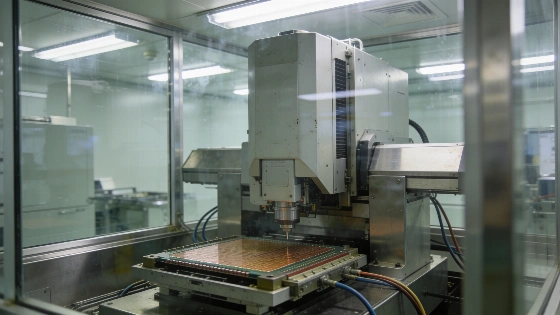
ASML reported €11.7 billion in quarterly sales and raised its annual outlook. Chip shares still fell as investors questioned AI financing and returns, with oil prices adding pressure.
Some ASML customers have asked about equipment orders for 2029 and 2030. That demand did little to reassure investors as chip stocks slid despite the company's strong quarter.
Micron fell 1.97% to $934.23 during Nasdaq trading. AMD dropped 3.95% to $581.61.
Intel lost 2.56% to $100.18. Marvell declined 4.29% to $257.20.
ASML credited strong demand and a favorable product mix for its results. Sales of services for its installed equipment base also supported the quarter, according to ASML's earnings release.
Pressure across chip stocks
Semiconductor shares were already under pressure on Tuesday. High oil prices weighed on the sector. So did concerns about financing AI investment, alongside advances by Chinese memory maker CXMT.
Rayliant strategist Phillip Wool called the market reaction to CXMT excessive. He said the company had not demonstrated large-scale production. Its progress, he argued, did not affect high-bandwidth memory, or HBM.
The iShares Semiconductor ETF has fallen for six consecutive trading sessions and was approaching a seventh down day. Barron's noted that a seven-session losing streak would be its longest since a seven-day decline in May 2025. The run of losses captures recent weakness, but it does not by itself show whether demand for chips or AI infrastructure has shifted over a longer period.
ASML's results and limits
ASML reported third-quarter revenue of €11.7 billion and net income of €5.0 billion. Its gross margin, the share of revenue left after direct production costs, rose to 57.5% from 54.0% in the prior quarter. The company now expects full-year revenue of €44 billion to €45 billion, up from its previous range of €43 billion to €45 billion, according to finanzen.net. ASML also forecast fourth-quarter sales of €14.2 billion to €15.2 billion and a full-year gross margin of about 56%.
The more precise quarterly sales figure was €11.66 billion, just below the €11.72 billion analyst consensus cited by CNBC. Net income of €4.96 billion topped the €4.1 billion expected. Chief Executive Christophe Fouquet said planned supply for 2027 and 2028 would not fully meet customer demand. ASML is examining whether it can raise 2028 output beyond the roughly 30% increase already planned, CNBC reported.
Analysts disagreed on how much the quarter changed the outlook. Jefferies saw results broadly in line with expectations and called the capacity expansion positive but anticipated. JPMorgan judged both the results and forecast better than expected. ASML's place in the equipment supply chain also limits how directly its performance can lift chipmakers' shares. Demand from large cloud-computing companies, known as hyperscalers, remains a key factor for chip demand.
AI spending and financing
When equipment demand is strong, ASML may be able to charge higher prices. That could raise costs for customers such as Taiwan Semiconductor Manufacturing and Intel. Intel said in a joint announcement that it already uses ASML's High-NA EUV technology to produce its Intel 18A process. The equipment may support manufacturing plans, while adding to the capital burden chipmakers must manage.
Intel Chief Executive Lip-Bu Tan named access to capital and the cost of capital as potential challenges. He said he did not expect a significant slowdown over the next two to three years. Broadcom Chief Executive Hock Tan pointed to a different risk: AI spending could ease if use of new AI models falls short of expectations. These are executive assessments, not confirmed outcomes. Concern about financing costs also has a wider market parallel in recent Treasury yield pressure.
For chip companies, the economic case for AI depends on whether businesses use new models enough to sustain spending. Companies must also cover the cost of financing and expanding capacity. ASML's revenue forecast points to strong equipment demand, but does not answer whether customers will earn back their AI investment.
Some customers have expressed interest in placing equipment orders for 2029 and 2030.