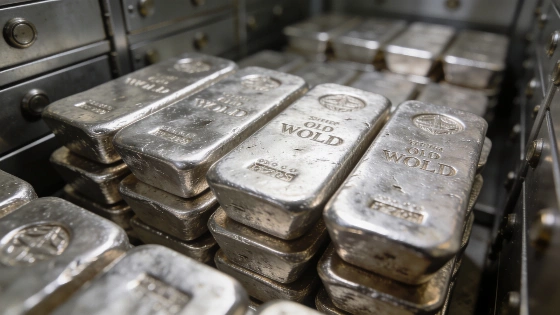
Silver prices have dropped sharply from their January peak but rising political and economic uncertainty could push demand higher as investors look for alternatives to stocks and traditional safe havens
Silver's sharp decline from its January high has prompted investors to reassess its role as a portfolio hedge. After climbing above $120 per ounce at the start of the year, silver has fallen to around $66, erasing months of gains and unsettling those who entered the market late last year. However, with the Federal Reserve's next steps uncertain and political risks increasing, silver's appeal as a defensive asset is once again under consideration.
In 2026, the global silver market is expected to remain in deficit for the sixth consecutive year, with the shortfall estimated at around 67 million ounces.
Fed Policy and Political Uncertainty
Investors now face renewed uncertainty over the Federal Reserve's direction. The central bank's independence is under scrutiny as the president threatens to halt trade with certain countries if interest rates are not reduced. This political pressure, combined with the approach of midterm elections, has added fresh volatility to financial markets. For those concerned about high stock valuations and the risk of policy missteps, silver is regaining attention as a potential safe haven.
According to a Reuters financial review, spot silver traded around $66-67 per ounce in early September 2026, following what analysts described as a "brutal year" for the metal. At its lowest in 2026, silver had dropped by as much as 55% from its January peak, including a 41% decline in that month alone. This volatility has been closely linked to shifting expectations for U.S. monetary policy, with the probability of a Fed rate hike at the September 15-16 meeting rising to about 65% after stronger-than-expected U.S. employment data.
In early September 2026, silver repeatedly rebounded above $66.5 after dipping below $65, reflecting not a one-off collapse in demand but persistent sensitivity to interest rate expectations and the strength of the U.S. dollar.
Silver's Role in a Diversified Portfolio
For investors seeking exposure to silver without the complexities of physical ownership, the iShares Silver Trust (SLV) provides a liquid, exchange-traded option that tracks the metal's spot price. SLV enables investors to incorporate silver into their portfolios alongside stocks and bonds, offering a potential hedge against both inflation and market shocks. With the S&P 500 near record highs, some are questioning whether broad equity exposure alone is sufficient to withstand future volatility.
It is important to note that silver's performance does not always move inversely to stocks or bonds. The metal can underperform for extended periods, and its price is influenced by factors such as industrial demand and speculative trading. Nevertheless, for those concerned about concentrated equity risk, a modest allocation to silver-through SLV or similar funds-can add diversification that may help reduce portfolio fluctuations.
Data from the World Silver Survey indicates that global silver demand reached 1.24 billion ounces in 2023, with investment demand accounting for approximately 25% of total usage. The U.S. Mint reported a 15% increase in American Silver Eagle coin sales in the first quarter of 2024 compared to the same period a year earlier, reflecting renewed retail interest as market volatility increased.
Risks and Practical Considerations
Investing in silver carries notable risks. The metal's price is highly volatile, and sharp reversals are common. Unlike gold, silver's industrial applications mean its price can also be affected by changes in manufacturing and technology demand. Investors in funds like SLV should also consider management fees, tracking error, and the potential for premiums or discounts to net asset value during periods of market stress.
For those considering silver as a hedge, it is essential to evaluate how the asset fits within a broader investment strategy. Silver may help offset losses during equity market downturns, but it can also increase portfolio volatility if held in large amounts. As CNBC Indonesia/Reuters reporting notes, the market's reassessment of Fed policy-especially after strong U.S. jobs data-has been a key driver of short-term silver volatility in 2026.
Silver's reputation as a safe haven is based on its long history as a store of value, but its modern role is more complex. Unlike cash or government bonds, silver does not generate income, and its price can be influenced as much by speculative flows as by fundamentals. Investors should carefully weigh the trade-offs between potential protection and added volatility, and consider their own risk tolerance, investment horizon, and liquidity needs before making silver a core part of their portfolio.